
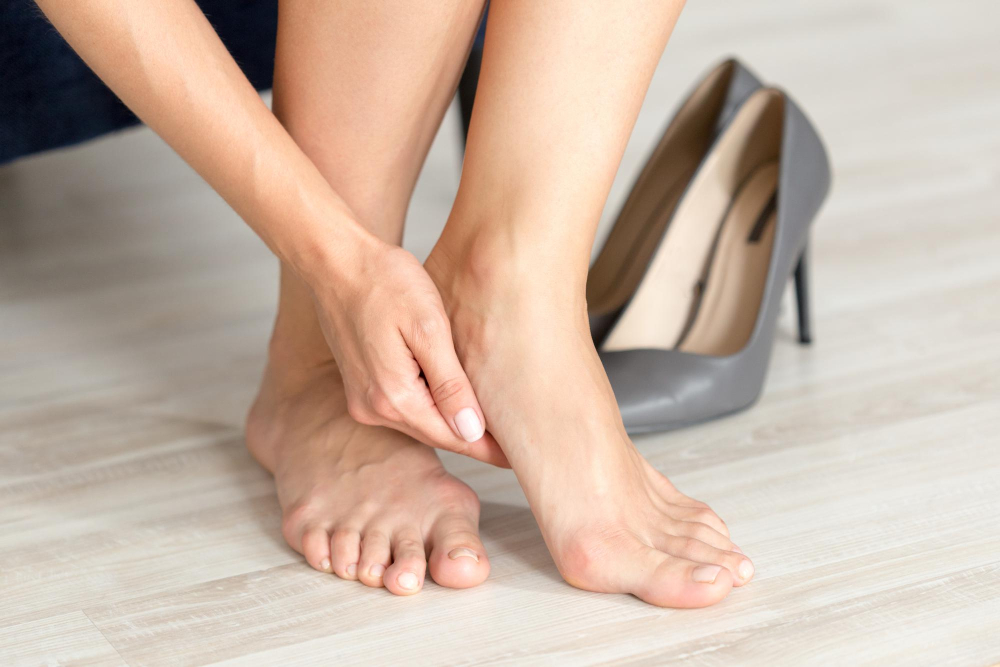
So, when do your knees start to ache, your hips feel stiff and your lower back have permanent pain radiating through the last thing you would think about may be your feet? Many people tend to treat joint pain at the site itself, for example using a heating pad on the lower back or wearing a knee brace during exercise. But human anatomy works as an interconnected web meaning that whatever is going on closer to the ground will affect every joint above it. If unexplained sore joints have you down, the real culprit might just be right under your shoes.
Don’t let foot problems affect your whole body – schedule an appointment with our expert podiatrists today.
Body Structure and the Kinetic Chain
In biomechanics terms, the kinetic chain is how the body depends on specialists. Imagine your skeleton as a chain of links, where your feet hold your ankles, which hold up the knees that are connected to the hips that stay in place with help from your spine. If you have normal feet, they function like natural shock absorbers and disperse your body weight equally as you step.
Yet when your feet do not have the support they need, or if you roll your foot in or out, that stable base falls apart. Over-pronation of the foot is characterized by lowering an arched foot, which causes both the lower leg bone and thigh bone on the same side to rotate inward. This pulls inward toward the body’s midline pulls on cartilage in the knee joint. That internal leg rotation then ends up rotating the pelvis forward, which creates a constant strain on the lower back muscles and spinal discs.
Joint Pain Caused by Common Foot Conditions
The few common foot problems change the way you walk, dictating how the rest of your body compensates. A flat foot with a non-functional arch will transmit the most shock into the knees and hips instead of being taken up by the foot. On the other hand, a high arch is stiff and does not provide effective shock absorption, transmitting hard impact forces directly into the legs and lower back with each foot strike.
And other conditions induce similar cascade effects through the whole body. If you have plantar fasciitis and severe heel pain, you’re going to unconsciously alter the way that you walk in order to avoid weight on the heel, putting undue stress on all these body parts on your opposite leg, hip, and spine as well. Similarly, painful toe deformities like bunions and hammertoes inhibit proper toe-off as you walk, shifting your center of gravity and creating postural imbalances.
Before you give up, Hello Podiatry doctor Bronx
If knee, hip, or lower back pain has been bothering you for a few years contact us today because addressing the underlying cause at ground level is key. Magnet Health’s experienced podiatrists at Magnet Health Podiatry in Bronx specialize in comprehensive foot care, advanced gait analysis, and custom orthotic solutions to realign your foundation. If you are looking for specialized podiatric care near me, this can be the best way to help your foot recover from an injury while also helping alleviate pain that affects functions of your kinetic chain due to chronic joint misalignment.
The Impact of Foot Misalignment on Knees, Hips, and Back
It occurs, in part, because you train your knees to bend when the knee is a hinge joint that wants to go primarily back and forward not sideways. As overpronation distorts the lower leg inside, so too is the knee joint twisted out of position is a situation that results in runner’s knee, meniscus wear, and faster joint degeneration. As you go up higher, your hips must now work overtime to hold the pelvis level. Inward rotation of legs brings the hip flexors and gluteus muscles into a position wherein they tighten up and together this often causes hip bursitis and chronic tightness.
This mechanical force finally comes down to the lower back where tilted pelvic makes embolden density at lumbar spine directly. If your foot mechanics pull the pelvis forward or asymmetrically side to side, then muscles along your lower back must work all day long to hold you up. This muscle tension is what causes the muscles in your lower back to go into spasm and irritates the sciatic nerve so it triggers pain, numbness, tingling as well as wearing down our spinal discs faster than they should.
Identifying the Red Flags and Nurturing Relief
To know whether you are having back pain or knees pain due to your feet issues, there are some warning signs that can guide you. Notable shoe wear patterns on the inner or outer edge of your soles are an indication that you need even better footwear, while pain that persists after walking in hard surfaces suggests insufficient arch support. Another warning sign that your bad foot mechanics are hurting the rest of your body is frequent ankle rolling and morning heel stiffness.
To find relief, your foundation needs to restabilize through specialized care and support. An expert gait evaluation can help detect structural problems in your walking pattern, by having a specialist assess your foot movements and prescribe custom orthotics to fix pronation. Using supportive footwear in conjunction with exercises to improve your calves, Achilles Nevia and hip flexors take stress off the kinetic link and allows both feet to move more comfortably across all joints of the body.